dlt (data load tool)
Open-source Python library that moves data from any source into your warehouse, handling schema and normalization for you.
🔗 Visit dlt (data load tool)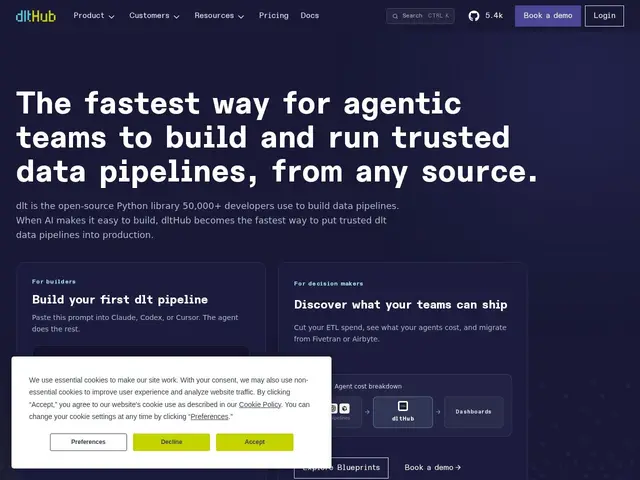
Description
Companies that want to analyze their data first have to gather it from many places — sign-up forms, payment systems, internal apps — and load it somewhere it can be queried, like a data warehouse. Writing that plumbing by hand is repetitive and breaks whenever a source changes shape. dlt is a free code library that does this automatically: point it at a source and a destination, and it figures out the structure and keeps it updated.
dlt is an open-source Python library for building data ingestion pipelines that extract, normalize and load data from over 5,000 sources into warehouses and databases including Snowflake, BigQuery, Databricks, Postgres and DuckDB. It automates schema inference and evolution, handles incremental loading, and cuts the boilerplate typically written by hand for each new data source. Around the free core library, dltHub is a managed platform adding an agentic MCP-based assistant that generates REST API pipelines from natural language, production deployment with scheduling and monitoring, an interactive DuckDB-backed notebook workspace, and integration with dbt for downstream transformation. The core dlt library is Apache 2.0 and free forever; dltHub's managed layer has free and paid tiers.
💬 Our review
The short version: if your team writes custom Python scripts to move data into a warehouse, dlt replaces that boilerplate with a maintained library, for free — and it's become the default answer for teams that want ETL as code rather than a GUI tool.
dlt's appeal is being a library, not a platform: it drops into an existing Python codebase, an Airflow DAG, or a serverless function, rather than demanding you adopt a new UI-driven tool. Automatic schema inference and evolution — the part that traditionally breaks pipelines when an API adds a field — is the genuine time-saver here, and 5.6k GitHub stars plus 4,000+ commits show real, active adoption. The MCP-based natural-language pipeline generation in dltHub is a 2026-native touch, letting an agent describe a REST API pipeline instead of hand-coding one. The honest trade-off: as a code-first tool it has more of a learning curve than fully managed GUI ETL platforms (Fivetran, Airbyte Cloud), and you're responsible for orchestrating and running it yourself unless you pay for dltHub's managed layer. For data/analytics engineers comfortable in Python who want control and no vendor lock-in, dlt is close to the best default; teams wanting a point-and-click connector catalog with zero code should look at Airbyte or Fivetran instead.
💰 Pricing
📊 Global score
🤖 AI-enriched data
dlt core library free forever (Apache 2.0); dltHub managed platform has free dev tier plus paid production tiers
Pros
Code-first Python library, no vendor lock-in
Automatic schema inference and evolution
5,000+ sources, all major warehouse destinations
Cons
Requires Python comfort — no no-code UI for the core library
Self-managed orchestration unless you pay for dltHub