NocoDB
Self-hostable Airtable alternative: spreadsheet UI over your Postgres or MySQL, REST APIs, forms, kanban and RBAC.
🔗 Visit NocoDB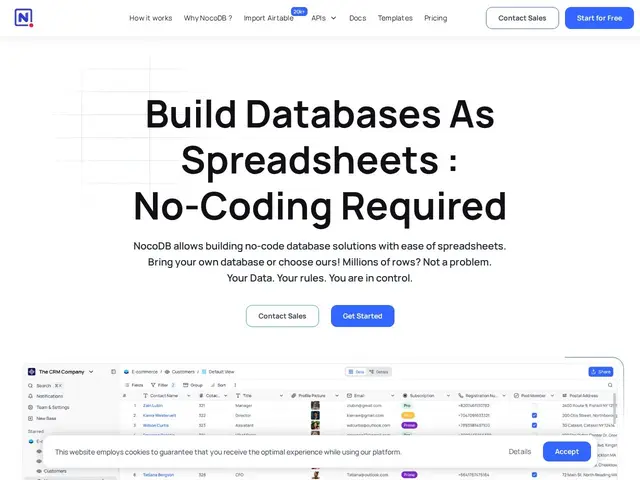
Description
NocoDB turns a technical database into something that looks and works like a spreadsheet, so colleagues who don't code can browse and edit company data safely. It plays in the same category as Airtable, with one big difference: you can run it on your own servers, on top of a database you already have, without paying per user.
NocoDB turns databases into a spreadsheet-like workspace that non-technical teammates can actually use. It either creates new bases from scratch or — its killer feature — connects to an existing Postgres or MySQL database and layers grid, kanban, gallery, form and calendar views on top, with filtering, grouping, role-based access control and an ERD view. Data comes in from Airtable, CSV or Excel imports, and gets out through automatic REST APIs, webhooks and SDKs, which makes it double as a quick backend or internal-tool layer. It scales to millions of rows, deploys via Docker (with SQLite or PostgreSQL as its own store) on macOS, Linux or Windows, and claims 35,000+ organizations, 20M+ Docker pulls and 64k+ GitHub stars. The code is public under a Sustainable Use License — source-available rather than classic OSI open source — with self-hosting free and a hosted cloud offering paid plans. The stack is TypeScript and Vue, with an active community of 6,000+ on Discord.
💬 Our review
The short version: Airtable's spreadsheet comfort, but on your own servers and your own data — with a licence worth reading before you build a commercial product on it.
NocoDB's genuinely differentiating feature is that it sits on top of your existing Postgres or MySQL instead of trapping data in a proprietary silo — the single biggest structural complaint about Airtable. Self-hosted, it turns a database plus a Docker container into forms, kanban boards and REST APIs for internal tools, at zero license cost for most uses; at 64k stars and 20M+ Docker pulls, community risk is low. Now the fine print: the license is a Sustainable Use-style source-available license, not OSI open source — fine for internal use, but read the terms before embedding NocoDB in a product you sell. Feature-wise it still trails Airtable on formula depth, automation polish and mobile experience, and very wide tables with many collaborators can feel slower than the SaaS incumbent. Cloud pricing isn't clearly published on the landing page, which is annoying for comparison shopping. Alternatives worth a look: Baserow (true open core, similar pitch), Teable (Postgres-native, fast), Grist (Python formulas). But if the requirement is 'Airtable UX on my own database, on my own servers,' NocoDB is the most proven answer.
💰 Pricing
📊 Global score
🤖 AI-enriched data
Self-hosted free (Sustainable Use License); cloud paid plans
Pros
Works on your existing Postgres/MySQL
No per-seat pricing self-hosted
Instant REST APIs
Cons
Less polished than Airtable
Source-available licence, not OSI