PostgresAI
AI-native Postgres observability: 45+ automated health checks, query and config tuning, agent-ready JSON and MCP output. Open source.
🔗 Visit PostgresAI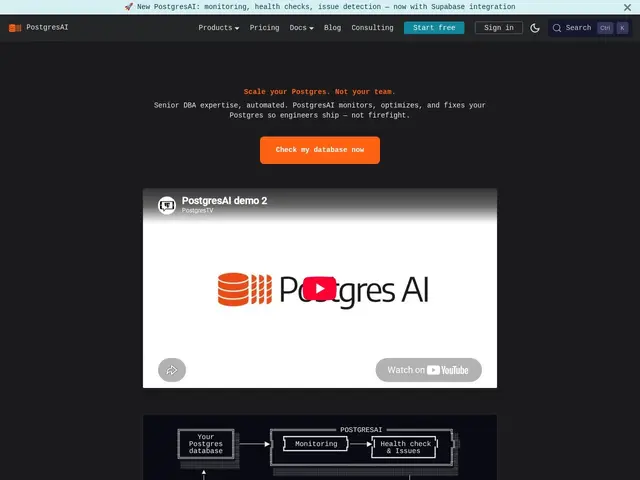
Description
Most serious apps keep their data in a PostgreSQL database, and that database needs constant care — checkups, tuning, fixing slowdowns — work usually done by a specialist called a DBA. PostgresAI is like an automated specialist: it watches your database around the clock, spots problems early, and suggests or applies fixes, so teams without a dedicated expert stay safe.
PostgresAI is an automated database management and observability platform for PostgreSQL, built by the postgres.ai team behind Database Lab Engine. It continuously monitors clusters and runs more than 45 automated health checks covering bloat, index health, query performance and security, then surfaces issues and action items the way a senior DBA would. Beyond monitoring, it handles index maintenance, query optimization with recommendations tested on database clones, and configuration tuning across 20+ Postgres parameters, and it detects performance cliffs such as LWLock contention, MultiXact exhaustion and transaction ID wraparound. Its distinctive angle is being AI-native: every diagnostic is emitted as structured JSON designed for LLM consumption, and it ships a Claude Code plugin and an MCP server so coding agents can read issues and act on them from the IDE. An express checkup mode needs zero setup, while the full stack adds Grafana dashboards following the Four Golden Signals. It supports PostgreSQL 14-18 on self-managed servers, Kubernetes, RDS, CloudSQL and Supabase, with an Apache 2.0 open-source core and a managed service at console.postgres.ai.
💬 Our review
The short version: a young but serious tool that automates the expert work of keeping a Postgres database healthy — made by a team that has done exactly that job for a decade.
PostgresAI encodes real, hard-won expertise: the postgres.ai team (Database Lab Engine, postgres-checkup) has done production Postgres work for companies like GitLab and Miro for years, and the 45+ health checks reflect that lineage rather than a thin AI wrapper. The agent-native design — structured JSON diagnostics, MCP server, Claude Code plugin — is a genuine differentiator in 2026; most competitors still assume a human reading dashboards. Caveats: the unified product is very young (v0.15.x, low GitHub star count at launch), and managed-service pricing is only visible after sign-up, which makes budgeting annoying. If you just want mature query monitoring, pganalyze is more polished; if you already pay for Datadog, its Database Monitoring covers the basics; pgwatch and pghero remain fine free options for simple setups. But the Apache 2.0 core makes PostgresAI cheap to trial, and for teams wiring AI agents into their ops loop it is currently the most credible Postgres-specific option. Treat its autonomous fixes with normal production skepticism: review before applying.
💰 Pricing
📊 Global score
🤖 AI-enriched data
Apache 2.0 open-source core free; managed console priced on sign-up
Pros
45+ automated health checks
Agent-native (MCP, JSON diagnostics)
Free self-hostable core
Cons
Very young unified product
Managed pricing behind sign-up